Network of Material Colors
2024
This network explores the color relationships between over 3,000 materials from the IRUG Spectral Database, an international archive of infrared and Raman reference spectra contributed by museums, conservation labs, and cultural heritage researchers. Founded to support the scientific study and preservation of artworks and artifacts, IRUG (the Infrared and Raman Users Group) facilitates the sharing of peer-reviewed spectral data across the cultural heritage community.
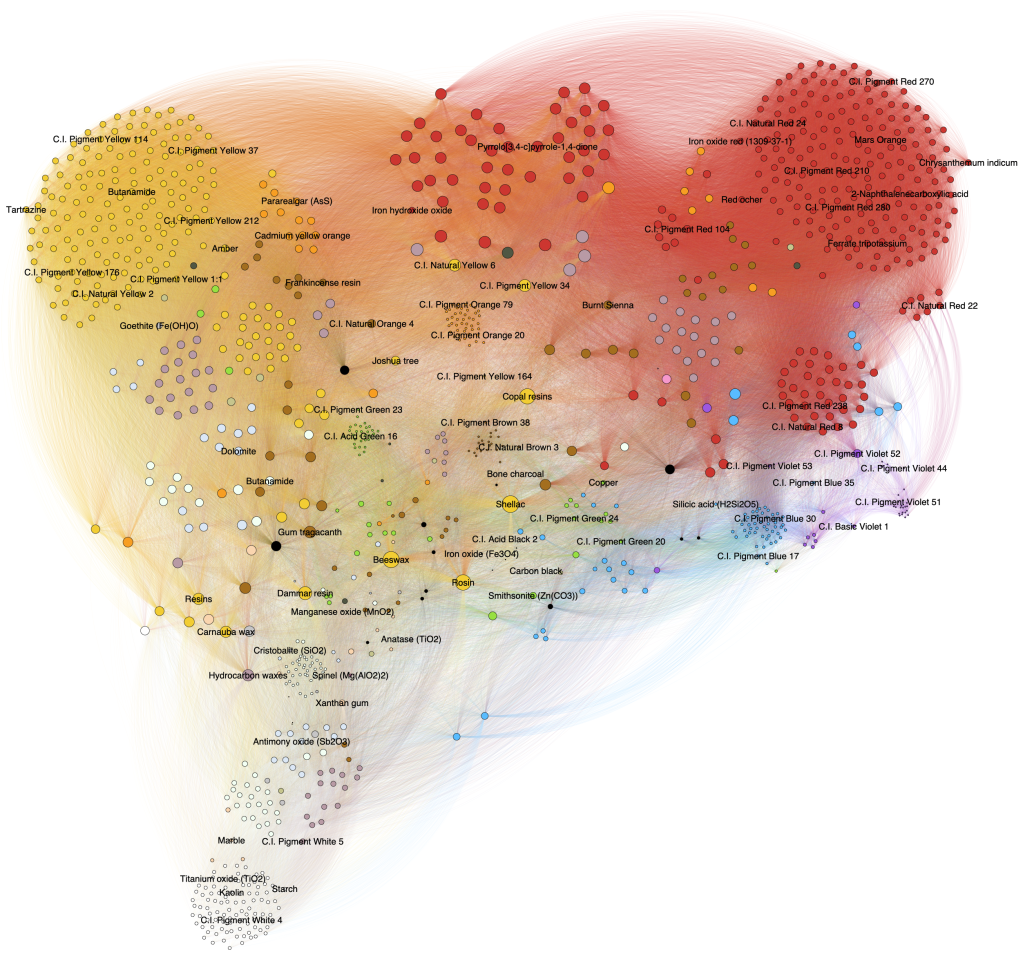
Each node in the network represents a material from the database—such as natural dyes, inorganic pigments, or synthetic resins—and edges connect materials that share the same display color. Node color corresponds to the material’s visual appearance, forming a chromatic topology that reveals clusters of color-linked materials across diverse chemical classes.
While IRUG’s primary focus is spectroscopy, this visualization reframes the database through the lens of material color, offering a novel way to explore both visual and structural patterns across artistic and historical substances. Contributors to the database include institutions such as the British Museum, the Academy of Fine Arts Vienna, the Institute of Museum and Library Services, Los Angeles County Museum of Art, and the Museum of Fine Arts Boston, for mentioning a few.
This network opens new possibilities for art material research. It invites questions like: Do color-based clusters reflect historical pigment substitutions or trade patterns? Can visual similarity reveal affinities between synthetic and natural materials? Might network structure help identify gaps or redundancies in current reference collections? By shifting from isolated spectra to relational patterns, this approach shows how network science can enrich cultural heritage studies.
Source: http://www.irug.org/about-us/the-database
Data accessed: November 5, 2024
 Yessica Herrera